Last modified: 2026-09-29 20:27:19
< 2026-09-24 2026-09-30 >I had a quick walk around the Haynes Motor Museum again today, this time paying particular attention to front axle arrangements.
The most common arrangement on older cars is to have one track rod linking the left and right uprights, and then a separate rod connecting the steering gearbox to just one side. This is usually either moving left-and-right roughly parallel with the main track rod, or forwards-and-backwards roughly perpeindcular to it. In some cases it is at random other angles, anything is fine.
Sometimes the steering rod connects to one end of the main track rod with a ball joint, and sometimes it connects directly to one of the uprights.
Usually the main track rod passes underneath the leaf springs.
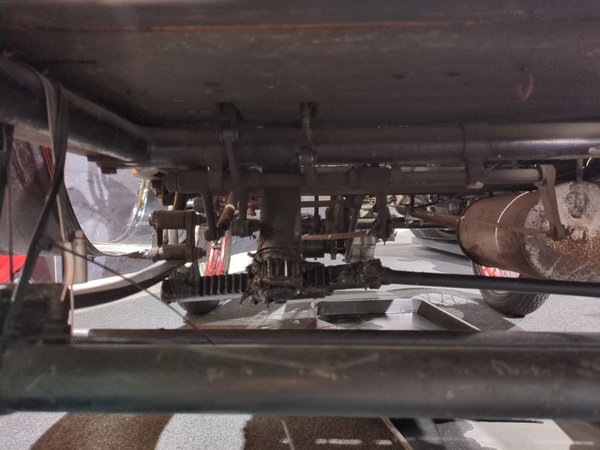
The 1900 Clement Voiturette has an interesting rack-and-pinion arrangement:
It is only connected to one of the uprights. I'm unclear on exactly how the rack is pushed against the pinion, it appears to just be floating in free space.
And this 1903 American car has the steering mechanism mounted directly to the beam axle:
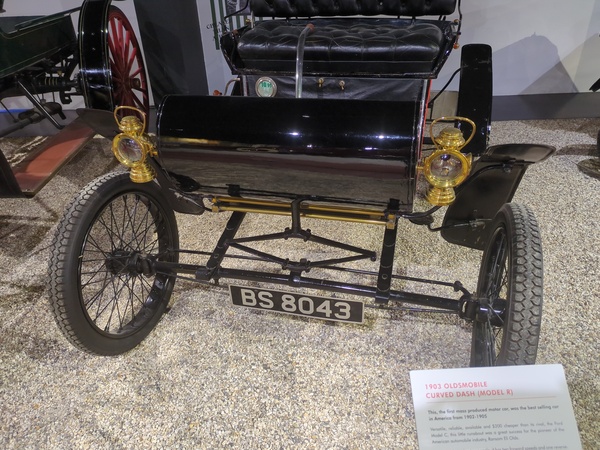
I had considered doing this kind of thing to eliminate bump steer but probably don't care. I think packaging is a more important consideration.
Instead of making a telescoping shaft to isolate the suspension movement from the tiller, they have a flexure, pretty good. Apparently the flexure was unreliable and prone to breaking though, swings and roundabouts.
I also wondered about using a chain and sprocket to make a steering rack, on the basis that a chain is really just a flexible rack.
I messed about on the lathe this evening and made a bunch of front wheel spacers.
The upright is going to have the big C-shaped piece, then the brake caliper bracket, then a steel spacer welded onto the upright, then an aluminium spacer which has to have a precise length to put the brake disc at the right point, then the hub, then another spacer to push the wheel nut out far enough to get a spanner on it, then the nut.
I have done 2 each of the steel spacers and the outer aluminium spacers, I'm saving the inner aluminium spacers until I know how long they need to be, which won't be until after I've welded up the rest of it.
< 2026-09-24 2026-09-30 >