
Last modified: 2026-05-06 16:08:25
< 2026-04-22 2026-05-07 >Well it is nearly 6 months since I started thinking about making a replica Old Bear Biplane, and I have not made much progress lately. If I don't hurry up my kids will be grown up before I've finished.
I was kind of stuck on how to attach the vertical stabilisers.
What I have done is cut a diagonal slit using the tablesaw, and then cut the stabiliser parts at a ~matching diagonal using the bandsaw, and I think this will suffice.
Looking at

I need to obtain dowels for the wing supports, wheels, axle, and propeller. What size did I have in CAD?
To do 5 biplanes I will need:
(Plus kerfs etc.)
FTSE 100 historical total return dataset
It is hard to get good data on which companies should have been included in the index over such a long time period. Bad data can contain a selection bias (includes early history of small companies which eventually went on to be included in the index), and/or a survivorship bias (doesn't include those companies that eventually got delisted). Both of these biases will tend to make small and volatile companies look better in the backtest than they were in reality. You also want the dataset to sanely handle things like share splits (where e.g. each share that used to be worth £100 is now 4 shares worth £25 each). And you want to know the total return (including dividend payments) rather than just the share price on each date, otherwise it will make companies that pay larger dividends appear to have worse returns.
Stooq has lots of free historical data in CSV format, it is easy to get hold of and easy to use, but, at least in the examples I checked, it suffers from:
And in any event, Stooq doesn't tell you index membership.
Another easy source is Yahoo finance, and Yahoo finance does adjust historical prices for splits and dividends ( https://help.yahoo.com/kb/SLN28256.html ), but it doesn't make it easy to tell which companies were included on a particular index on a particular date. However it could be a winner if we have some independent source to tell us (for example) which companies were in the FTSE 100 index on any particular data.
So what source could we use for index membership?
For the FTSE 100, LSEG publish it themselves, freely, https://www.lseg.com/content/dam/ftse-russell/en_us/documents/policy-documents/ftse-100-constituent-history.pdf . It's in PDF form, and names companies by name instead of ticker, but still, this would be adequate in a pinch.
There is also the Python library https://pypi.org/project/index-constitution/ which sounds more convenient although only covers Chinese and US indices, not UK. I found a (related?) Github project https://github.com/yfiua/index-constituents which does include the FTSE 100, and conveniently says that the symbols are compatible with Yahoo finance which is just what we want. So let's try that.
The index-constituents project has a web page at https://yfiua.github.io/index-constituents/ which lets you pick a month and download the data, but it only goes back to 2023.
Can I run the script manually to fetch older data?
Lol, it seems to work by using Wayback Machine to fetch historical versions of pages from the Bloomberg website. But because of that, it only lets you go back to 2008. Well that would be a start, let's get data back to 2008.
Launch with:
$ python index-constituents-repo/get-constituents-historical.py --indices ftse100
(Needs to be callled "index-constituents-repo" and launched from the parent directory for insane reasons).
But gets no data. Great. I think this is because archive.org is blocked by UK residential connections. (Strange that it was created by someone in China who appears to face no such restriction).
I guess try again but from a VPS. It is super slow from my VPS, I guess for apartheid-web reasons. I'll let it keep going though and see if it works. Actually maybe archive.org is just slow, but the blocked version blocks you instantly so it seemed faster from home but for bogus reasons.
The next issue may be that Yahoo finance can't show us data for delisted companies. An example is "Woodbois" was delisted last year, but https://uk.finance.yahoo.com/lookup/?s=WBI.L has no results now. Stooq doesn't have them either.
Ah! But Stockopedia does, and I already know how to grab out historical price data from Stockopedia. So potentially this is possible. Unfortunately this Python script doesn't seem to be doing very well at getting historical FTSE 100 constituents. Maybe the LSEG data is better. I guess for a first pass I have an LLM turn the LSEG PDF into a CSV or something, and I manually fix up the tickers, and then we grab out data from Yahoo for all that we can, and for any missing data I go and get it from Stockopedia.
Interestingly it looks like there have been periods when the number of constituents has not been equal to 100.
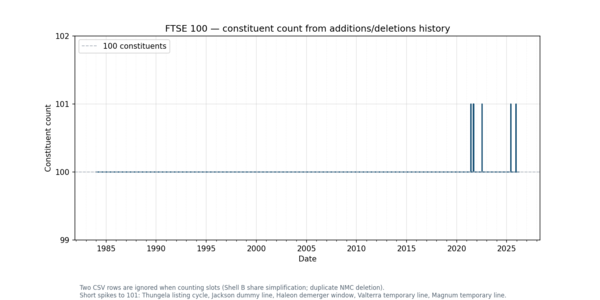
I gave the PDF to both Cursor and ChatGPT, Cursor spent a load of time writing code to programmatically transform the PDF, idk what ChatGPT did, but ChatGPT did a better job.
So now I have a CSV that encodes the information from the PDF. I would need to merge this with a full list of current members, and then work backwards through the CSV to find out what the membership was on any previous date. That's no big deal. I also want stock tickers, not just company names. I'm asking a fresh ChatGPT context to annotate that.
< 2026-04-22 2026-05-07 >