Last modified: 2026-03-30 15:36:20
< 2026-03-29 2026-03-31 >Todo is:
Case holes increased to 2.1mm diameter.
Lever holes also increased to 2.1mm diameter. These ones need to be tighter than the case ones, but I think they were so much tighter because they're printed in ABS-GF and the case was PLA.
Before I work on removing material for clearance, I am going to restructure the CAD to use LinkGroups so that I can work through the motion by editing angles only, no more dragging coordinates around. I want everything to pivot about its actual pivot, including the locations of the lever pivots to move as the key moves.
So:
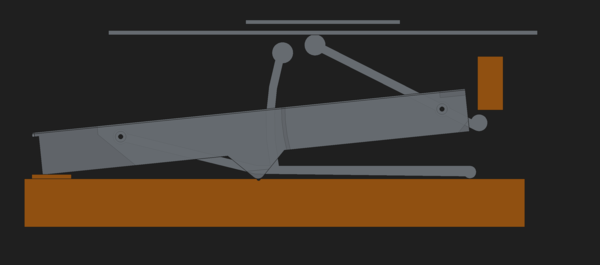
Here we have a fully-bottomed key:
I will fix the damper interference by changing the shape of the damper lever.
To fix the hammer interference I need to remove material from the keylever.
I think the hammer wants to get a ball-bearing in its end to make it heavier and to make it louder. I have quite a good collection of 4.5mm diameter balls, are they too small? I also have some 6mm and some just shy of 7mm. If I use anything bigger than 4.5mm then I'll definitely have to buy more if I want to make the full keyboard, so let's try 4.5mm for now and I might get away with not buying more. I guess just make a divot in the end of the hammer and glue the ball into it?
The hammer and damper have been reduced to 6mm. Previously the hammer was 7mm and the damper 8mm, unsure how I made that blunder. Also the pivot shoulders increased to take up the extra gap.
Hammer now has provision for a metal ball.
I don't have suitable felt pads for the damper, ignore that for now.
OK, the keylever wants a pivot pin in the middle and an alignment pin at the bit you press. With the new damper shape there is now plenty of room to put a pivot pin in the middle, that's good. Maybe 3mm or 4mm. I have a small amount of both sizes, I guess go for 3mm for now, and increase if it seems too flimsy.
OK, great, I think this is it for the keylever, hammer, and damper:
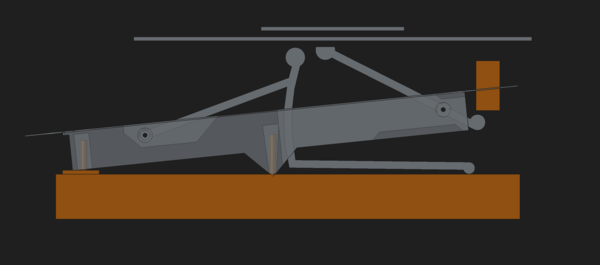
Would be good to be able to print it without mouse-ears, figure that out later. I guess print this iteration now?
And what am I going to do for a test stand?
For getting a large number of short metal pins, the search terms I want are "dowel pins" and "parallel pins".
The front rail pin is 95mm away from the balance pin.
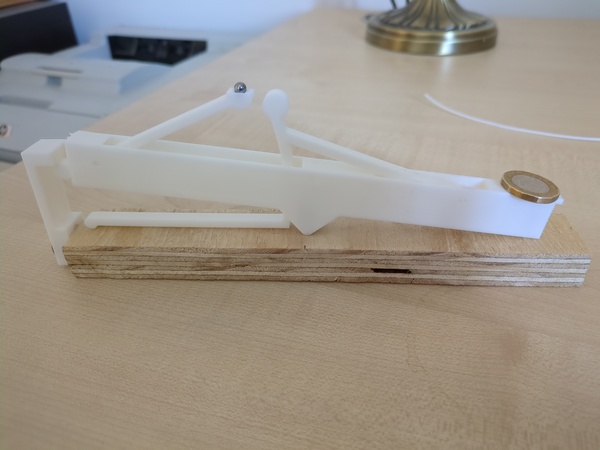
OK this is looking quite promising!
Issues now are:
I think we want to add extra mass to the hammer to increase the activation force. We want as much of the finger energy input as possible to go into the tone bar, which means it needs to go into the hammer.
To increase the mass of the hammer ball by 16x it would need 2.5x the diameter, or 11.25mm. That will not fit within the inner cavity of the key lever.
I put one end of the mechanism on a digital scale and it measured about 3g at the point that the key started to lift up, so my earlier estimate of 16x to get 50g was pretty much spot on.
Actually there are two ways of looking at this. One is that the action ratio is 5x and I need to add 47g of load, so I need to increase the hammer weight by 47/5 = 9.4g. The other is that I need to increase the overall load by 16x, and if the ball is currently about 0.3g then it needs to be 0.3 * 16 = 4.8g.
Maybe the effective action ratio is more than 5x because the pivot point is dropping while the ball rises.
I think I will try to affix a 2nd ball to the hammer and see how much the measured activation force increases.
I stuck it on with blu-tack, the blu-tack and ball together weighed 0.5g on my scales, and the initial activation force has increased from about 2.5g to 4.4g. Adding a second ball but no more blu-tack takes it up to 6.0g, and the 2 balls plus blu tack weighs 0.9g. So we can infer that the blu-tack weighs 0.1g.
And actually I weighed 10 balls and got 3.6g, so the balls are 0.36g and the blu-tack is 0.18g.
After a bit of back and forth I managed to get a repeatable setup and I measured:
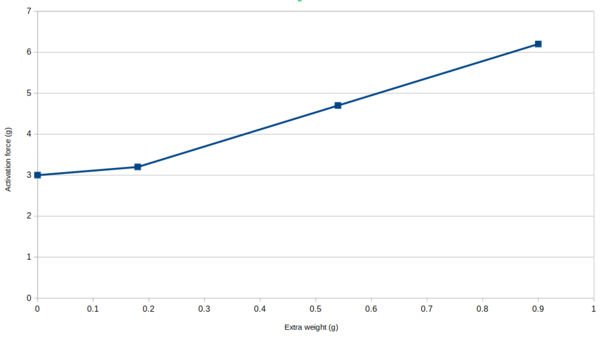
So that looks reasonably linear after the blu-tack is added, let's extrapolate to get 50g activation force and see how much weight we need to add to the hammer? I guess the gradient is about 4:1, i.e. for every gram of weight you add to the hammer you get 4g of extra activation force, so I'd need to add about 12.5g to get 50g of activation force, which is a larger estimate than either of my previous guesses.
I also tried resting a £1 coin on the hammer, activation force was then about 30g, and the coin weighs 8.8g, so then we get a 3x return on weight added to the hammer, which would imply I need to add 16.6g.
So, in conclusion, it will take between 4.8g and 16.6g added to the hammer weight to get us 50g activation force. I think the 16.6g figure is likely to be the more accurate end, given that it was derived from the finding that 8.8g only gets a 30g activation weight, which is already a lot more than 4.8g and evidently still not enough.
So I guess let's either work out how to add 16g to this hammer, or else increase the lever ratio.
< 2026-03-29 2026-03-31 >