Last modified: 2026-04-02 09:17:24
< 2026-03-30 2026-04-02 >Todo is:
The activation force thing is the biggest problem. I did some maths yesterday about how much mass I would need to add to the hammer, and it is probably about 16 grams, which seems a lot. So probably I want a combination of adding mass to the hammer, and increasing the lever ratio.
The goal is to effectively couple energy from the player's finger into the tone bar. So ideally all of the energy that the player is putting in is going to go into the tone bar rather than into the case or the damping.
So the first step is that force application on the key lever accelerates the hammer. And the second step is that there is an impact between the hammer and the tone bar.
Given that the purpose of the impact is to bend the tone bar to set it resonating, I don't know if modelling the tone bar as a rigid body is the right thing to do, but I will start with that.
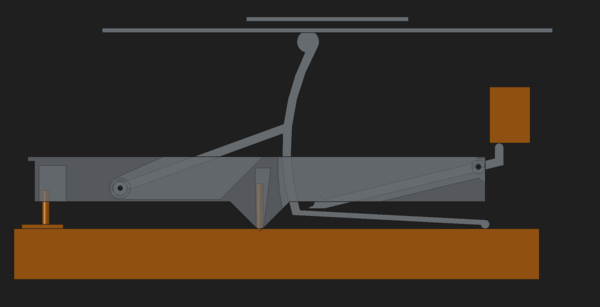
If we say it takes 50g to start the hammer moving, and we apply 51g, then we have 50 grams overcoming the weight of the hammer and 1 gram accelerating it. And the hammer moves up 4x as far as the key moves down. So key goes down (in my measured example) 12mm and ball comes up 48mm.
We know that work = force * distance. So we put in 612 g.mm, if all of that goes into the hammer that weighs 5g and moves 48mm then we have 372 g.mm going into acceleration,
over 48 mm gives us 7.75 grams of acceleration, or about 1.5x weight, so 15 m/s^2.
v^2 = u^2 + 2*a*s, so final velocity is sqrt(2*15*0.048) = 1.2 m/sec.
Our 612 "grams-force millimetres" is worth 0.006 Joules.
Kinetic energy is 1/2 * m * v^2 = 1/2 * 0.005 * 1.2^2 = 0.0036 Joules, or about 61% of our input energy goes into the hammer's velocity. That seems OK to me. So that suggests
that simply increasing the mass of the hammer would work.
And then how do we effectively couple that into the tone bar? If we compare to billiard ball impacts, you optimise energy transfer by making the masses equal? That doesn't sound right.
We're not trying to make the tone bar start moving as a rigid body at 1.2 m/sec, we're just trying to bend it slightly so that it starts oscillating. Also, annoyingly, if we actually do want to tune the hammer mass to the bar mass then that suggests that we will want a different hammer mass for each bar, which then means we will have either different activation force on each key, or a different lever ratio, both of which seem bad. Maybe it's better to tune the hammer mass for the middle bar and accept suboptimal energy transfer on the others.
ChatGPT worked through the maths to find out what the equivalent mass of the flexible bar would be, and it thinks that for the shorter bars it is about 5g and for the longer bars about 15g, so actually I probably don't want to be adding too much weight to the hammer, maybe double it, and mainly increase lever ratio.
New version:
Now accommodates a 6mm ball (+140% mass) and swings through a much larger angle, although hard for me to work out what the exact lever ratio is, it may be as much as 10x now, unsure. This actually may overshoot the 50g activation force if so, because 2.4 * 10 = 24x, 24 * 3 grams = 72 grams.
Print it and see.
< 2026-03-30 2026-04-02 >