Last modified: 2026-11-22 21:26:26
< 2026-11-21 2026-11-23 >I tried to cut out the roller plates using the plasma cutter.
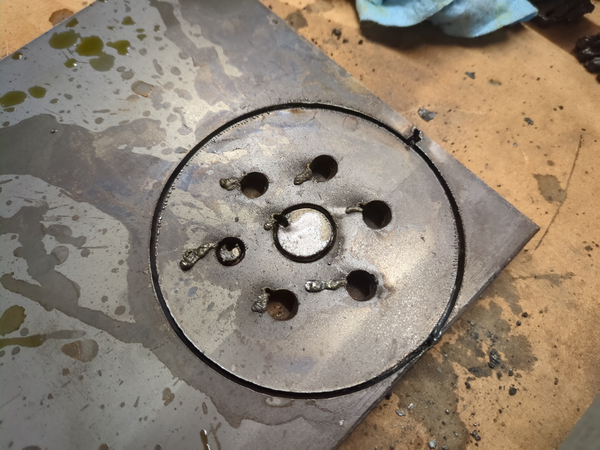
First one, top side:
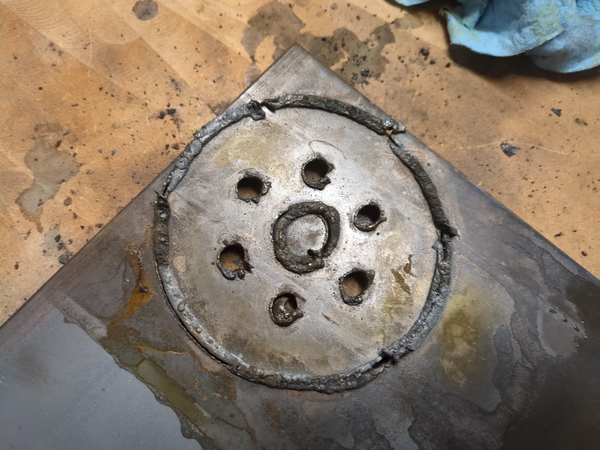
So again loads of bottom-side slag but again hammered out really easily.
There was a disconnection & reset on lighting the arc for the 4th hole on this one, I just deleted the first 3 holes from the gcode and ran it again and it completed.
Pretty bad bevel.
I then reversed the torch in its holder by 180 degrees before running the same job again.
https://www.youtube.com/watch?v=YI_tabzV42s
Second one, top side:
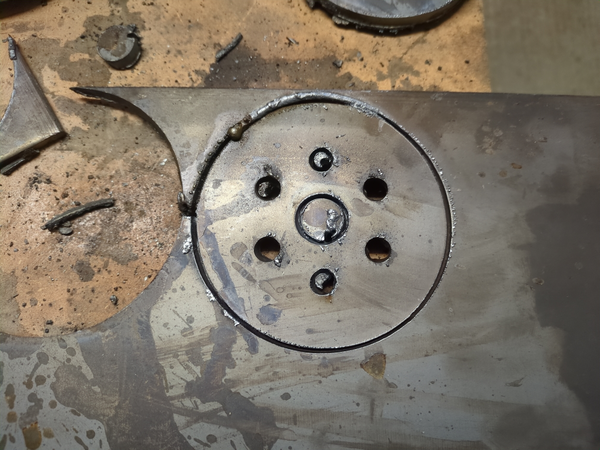
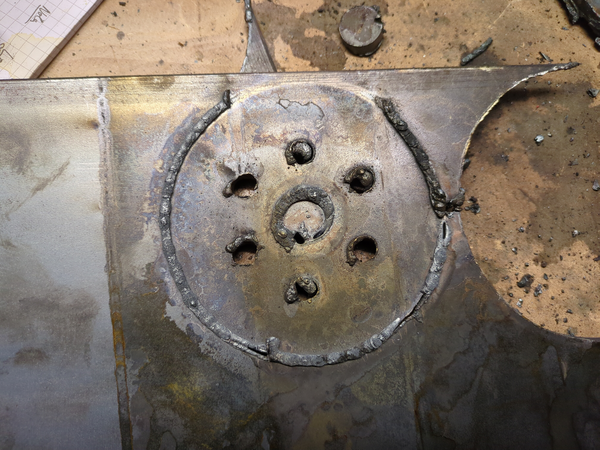
There was a portion of this one that didn't cut all the way through, and an even worse bevel than on the first one.
The bevel is in the opposite direction so it is (at least mostly) to do with the torch rather than the machine alignment.
I noticed it made a whistling noise during cutting a few times, what does that mean?
I'm not sure these parts are going to be usable, the bevel is much too bad.
How can both of my torches not produce straight jets??
Am I just persistently buying cheap and nasty torches?
Would be good to know if thinner steel gives a straighter cut. It may just be that 5mm is too much? Seems wrong though, everyone says 30A is good for 5mm steel.
I will look at the consumables and see if anything looks wrong.
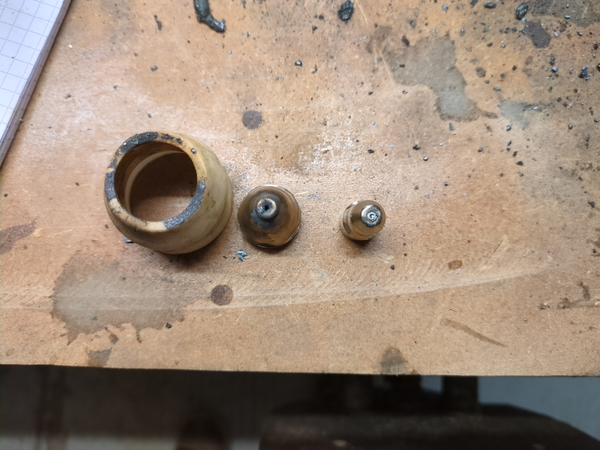
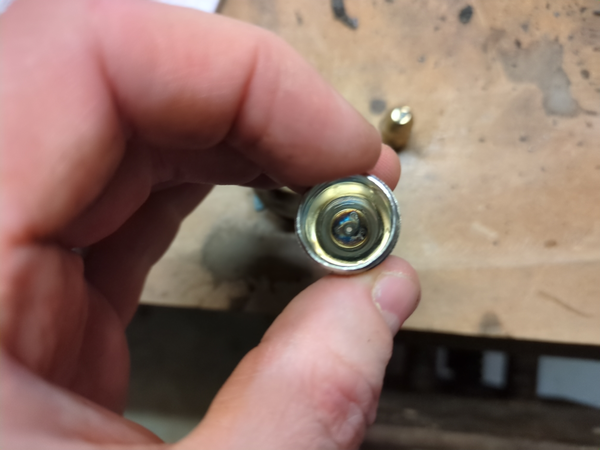
All looks fine to me?
Why could the jet be angled?
Why is the bevel so much worse today than it was yesterday though? I didn't change anything in between?
Oh, just noticed there is a burn mark on the inside of the torch on one side, is that normal?
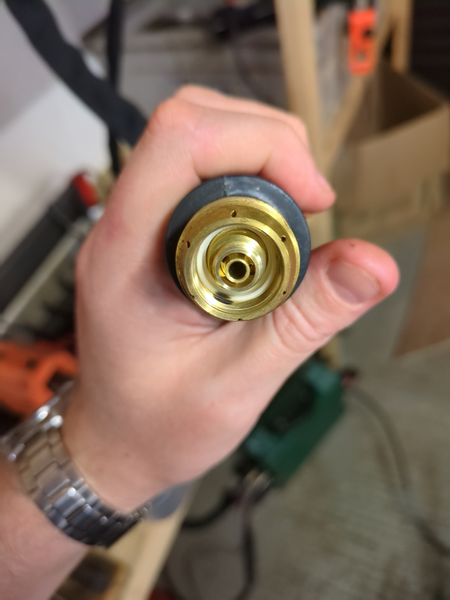
I wonder if I should make a way for me to manually disconnect the pilot arc return and see if the plasma jet straightens up when that's disconnected?
Also I noticed there was some water in the water separator and I've drained it now. Would increasing levels of water in the water separator bowl somehow cause the cut to get progressively worse?
One way to do this is to completely disconnect the pilot arc return, and then bridge the nozzle and workpiece by wedging a piece of metal under it, and then once the arc is lit knock the piece of metal out of the way. Or even just have the piece of metal stay in place and the CNC machine moves the torch out of the way.
If we find that the cut is nice and straight this way, then we know that the problem that is deflecting the plasma jet is caused by the pilot arc staying lit inside the torch.
My expectation is that the cut is still bevelled, but I think worth a try given how easy it is.
One argument in favour is that the pilot arc return method is common to both torches, and we know the problem is common to both.
Although I don't see why that would make it consistently lean in the same direction? Maybe if the pilot arc has a preferential attachment point inside the nozzle?
I posted on reddit: https://www.reddit.com/r/plasmacutting/comments/1y2xc85/why_is_my_machine_cutting_a_parallelogram_kerf/
Another theory is that we are just wearing out consumables really fast, could be to do with moist air, or something else?
I'm going to do the pilot arc disconnection experiment first just to see what happens.
So the pilot arc experiment worked flawlessly, in the sense that it successfully lit the arc and transferred it to the work, but it still had a bevel. So that rules out the idea that the pilot arc is attracting the plasma jet.
I did then replace the nozzle and try again, but the very first cut kind of fucked up and threw a load of molten metal at the nozzle.
In for a penny, in for a pound, I put another fresh nozzle on and tried again, and it looks pretty good? My straight-X-line-cutting gcode still has like an unexpected Y-axis lead-in, not sure what that is about. It is conceivable that the HF start is making the servo motors jump, although I was unable to reproduce this by lighting the pilot arc without any material loaded, may need more investigation.
But with this new nozzle I was quite happy that the cut looked reasonably square, at least when cutting parallel to X.
So I tried a new roller plate, but this time it reset the microcontroller pretty much every other time it tried to start the arc. Unsure why. Could it be that there is some causal link between having a nozzle that is working properly and the level of HF interference? Don't know, need to fix regardless. Probably start by shielding the torch cable.
This part was again a total fail because it didn't fit on the workpiece, and me having to manually keep restarting the job meant the coordinates drifted so none of it lines up anyway, it was cutting air for a bunch of time and then didn't re-penetrate properly, just a total fail all around.
But the holes that it did manage to cut out don't look to have a bevel in any particular direction. They don't look good, the kerf tapers towards the bottom, but it's not a parallelogram and I could probably fix it with a drill if I cut it out of a piece of material that it actually fit on, and if it didn't keep resetting the microcontroller.
And actually looking at the old nozzles, they do seem to have a slight groove worn in them in one direction. Whether that is due to the deflected jet, or causing the deflected jet, I don't know.
So now we know that all the ChatGPT advice "try fresh consumables" actually might have been right? This machine is just wearing out nozzles at a prodigious rate. Whether that is because most of these nozzles start out kind of misaligned and therefore get worn sideways, or because I am abusing it because I don't know what I'm doing, I don't yet know.
Two hypotheses:
To investigate: