Last modified: 2026-11-17 14:44:34
< 2026-11-15 2026-11-18 >Plasma cutter current measurement
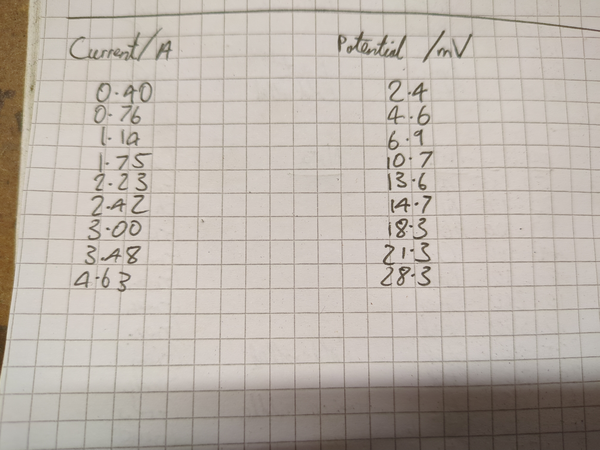
I connected up the bench supply to the work return clamp and measured the voltage drop from the clamp end to the other end at various currents:
Ohm's law says this should be a straight line and we get:
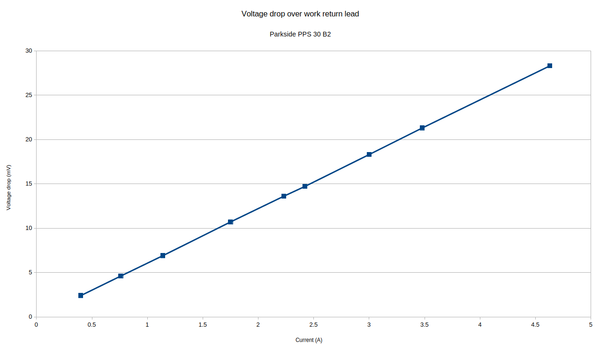
Which is absolutely spot on. I didn't expect it to be this perfect.
We get about 0.006 Ohms for the cable, does that sound believable to ChatGPT? Yes, apparently pretty much fits a 6 sq. mm conductor 2 metres long, good.
At 30 amps this would drop 180 mV which is easy to measure with the multimeter, apparently the HF start can cause high voltage transients that may damage the meter but can just roll the dice on that.
So next thing is to measure this while it is "cutting" and see what it says.
I pulled back the insulation on the work return plug to clip a lead on, and clamped the multimeter to the shelf so that both leads would reach their respective ends:
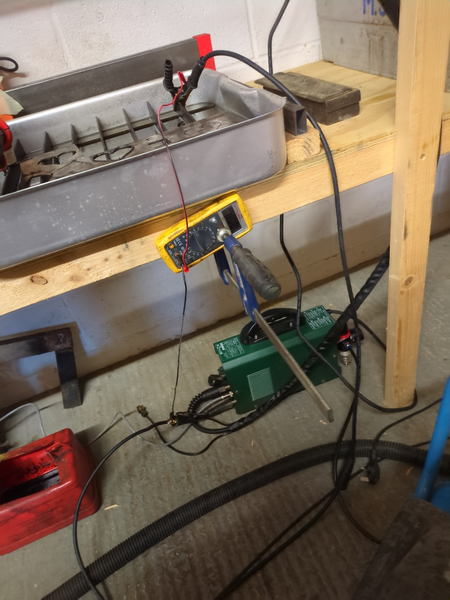
With cutting current set to about 20 on the dial, I meaured about 118 mV drop across the work return cable, which works out to 19.7 amps, so basically spot on.
So at 250 mm/min with a measured 20 amps cutting current, it didn't cut through 3mm steel. It's the lower cut here:
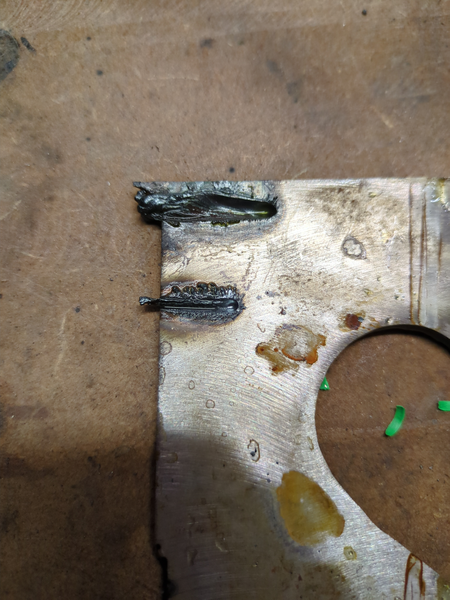
The nozzle very close to the work, less than 1 mm.
So, very encouraging that it is delivering the required amount of current, that's basically all I need from it. Still a bit sus about how much mains current it is drawing but bot says that could be due to the power factor? My AC clamp meter is apparently "true RMS" but unsure how that affects it.
Oh, also still need to measure the voltage at the plasma cutter plug, the wiring may be dropping the voltage too much causing it to draw more current to compensate, check that next.
Assuming the excessive current draw is just down to bad wiring, then I can give it a better circuit and a better torch and we should be in business.
There's an instantaneous drop to like 120 volts or something but steady-state drop is from 244v to 236v so probably no big deal there.
I am tempted to measure the AC current draw again. It is possible that when I measured it last time the torch-to-work distance was excessively high so it needed an excessively high voltage to sustain the cutting current?
With cutting current set to 20 amps it was initially drawing about 20A from AC on pilot arc or when approaching the workpiece, then 16 or 17 amps with arc correctly transferred. I turned cutting current up to 30 amps and it drew 22A from AC after transferring arc, possible that it was more than that before transferred, unsure. I think this is still higher than we'd expect?
So we know:
So I think I want to try a different torch.
Actually, one last thing, I will let the moisture out of the compressor and see if it makes any difference, I haven't done that for years.
Well I loosened the drain valve and got a couple of drops of black liquid out, which is all I've ever got out before, but then I decided to plug the compressor in with the drain valve open and at first nothing, but then something snapped and a big stream of rusty water came shooting out. Several hundred millilitres.
I then tried to tighten the valve back up and couldn't get it to seal, so I took the valve off and it is like a T-shape on the inside, so as you screw it "out" the top of the T seats against an o-ring, but the top of the T has sheared off, unsure if it has always been like this or I over-tightened it just now and broke it off. Also the bottom of the hole was all crusted up with limescale or something, which I've chipped off. So I guess the hole has basically been blocked off with the limescale or whatever it is, and that's why I've never managed to drain anything. So anyway I need to get a new drain valve for the compressor, annoying.
But on further consideration I think water in the air is not a significant problem for the cutting air, because the miniature water separator on the plasma cutter does not appear to have taken any water out of the air, which suggests there's not excessively much in it (?).
So need to buy: