Last modified: 2026-11-13 19:13:58
< 2026-11-12 2026-11-15 >I made up a new torch trigger cable using the shielded cable and it worked first time and every time since! Great result.
The new consumables do still make the jet come out at a bit of an angle, but a different angle to previous.
I cut a heart out at 500 mm/min and it cut all the way through almost all the way around, just one bit left attached, this makes me wonder if I made an error and my previous 1000 mm/min one was actually at 500? Seems unlikely. The gcode sender has a bug that forgets your feed override though and sets it back to 100%, so quite possible! Depends whether I achieved 1000 mm/min with feed override or editing gcode, can't remember.
So to correct for the jet angle I really need my torch to be able to rotate in both axes, annoyingly. I could make it rotate around the mounting screw for one axis and shim the mounting for the other?? Maybe, simmer on it for a while.
Pretty pleased with this though, I am quite close to being able to cut out useful parts. First ones will be the end plates for the tube bending roller.
Aaaargh, I've been trying to cut out one of the roller plates and it keeps blowing fuses. I no longer have the compressor and plasma cutter on the same extension lead.
I probably want to add a dedicated circuit for the plasma cutter and a different type of plug/socket. Very frustrating.
Apparently a 13A fuse is meant to withstand 20.8A for at least 30 mins so this isn't just slightly overloading the fuse, this is way over.
Would be good to actually measure how much current the plasma cutter is drawing. I have an AC clamp meter but don't think there's a convenient place to attach it, I may want to make an extension lead with separated conductors specifically for this purpose.
This is especially frustrating because it trashes perfectly good material every time it blows a fuse halfway through a cut.
I'm going to hack an extension lead and measure the current.
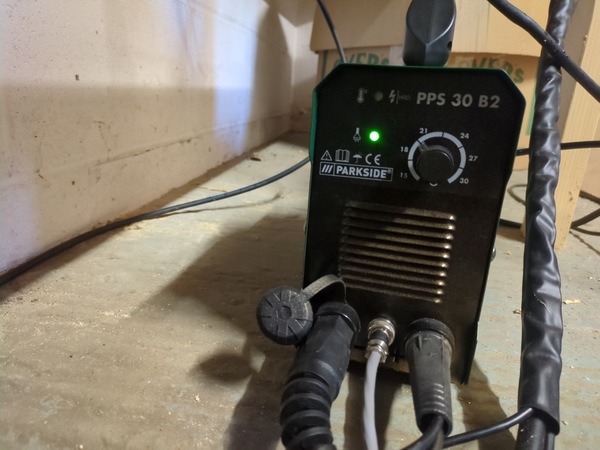
Clamp meter shows it is drawing about 32 amps! And actually works for surprisingly long before blowing the fuse.
Considering how much power it is drawing I am amazed it cuts so poorly.
Do people running a plasma cutter at home generally have to install a dedicated circuit?
I guess I can put the power controlling potentiometer back to the other end, or somewhere near the middle, and see if the problem goes away. I liked that it seemed to improve cutting performance but I don't recall it being a massive difference. Tilting the torch to make the jet point straight down was a bigger improvement.
With that screw all the way down, and then out a couple of turns (it's about a 25-turn pot), it was drawing 25 amps during the cut, and predictably it got a bit further but still blew the fuse.
Is this machine just a piece of junk? Am I sufficiently invested in plasma cutting that I replace it with something more sensible? Do I park the whole idea?
What about turning the current down so that the clamp meter says it is below 20 amps, and then aligning the torch so that the plasma jet goes straight down, and then see if it is looking like it will work?
OK so it draws just under 20 amps with the knob set to the line between the 18 mark and 21 mark:
But this is like nowhere near enough power. It can't cut even halfway through the 5mm plate at 90 mm/min. Very hard to know whether this is all a total waste of time or I'm actually only 1 or 2 small things away from having a satisfactory machine.
Also the problem where the ESP32 works for 30 seconds and then disconnects for 30 seconds returned for a while. As a test I set M3 but flicked off torch disable, so it wouldn't light the arc, and sat and watched it, and the torch light on the control panel stayed on across a disconnection, which means the ESP32 wasn't actually rebooting, and FluidNC state was maintained, but for some reason no communication for 30 seconds or whatever. Very strange.
I also noticed a few instances of the ESP32 resetting when the arc lights, not very many. Shielding the torch cable would probably help.
I think for now I park this and revisit some other time, current status is:
Maybe buy a proper CNC torch and retrofit to this machine and see if it works any better?? Or maybe just buy a better machine.
It doesn't manage to cut through 3mm steel at 100 mm/min with power set to ~20 on the dial.
I noticed that when it was doing the "30 seconds on, 30 seconds off" thing, dmesg wasn't reporting any disconnection, and
a continuous ping just showed dropped packets. Whereas when I actually reboot the ESP32 then dmesg shows WiFi re-authenticating
and ping shows "No route to host" or whatever while it is disconnected from WiFi.
So this suggests that packets are getting dropped for 30 seconds rather than WiFi actually getting disconnected. I tried it with the control cabinet open just in case it was too shielded but made no difference.
I've removed the Arduino ESP32 from the control cabinet and am powering it over USB-C on the desk, and the garage laptop also brought inside, will see if I can reproduce the problem. Annoyingly it very rarely happens so I don't know what I can do to reproduce it.
It's possible that the problem is something to do with either being in the garage or being in the control cabinet, seems unlikely though. Reasons it might affect things are: colder out there, different power supply, more stuff connected to pins.
Can't reproduce on desk, after half an hour of leaving it running for a bit, resetting it, reconnecting WiFi, power-cycling, just works as intended. Back to garage.
Reproduced in the garage straight away, and I logged a bunch of stuff per ChatGPT suggestion:
ping -D -O -i 0.5 192.168.0.1 | tee ping.logwhile sleep 2; do date -Ins; iw dev wls1 link; iw dev wls1 station dump; done | tee wifi.logsudo journalctl -kf -o short-iso | tee kernel.logjournalctl -fu NetworkManager -o short-iso | tee network.logI left these running unattended for a few hours while I was out.
What can we learn from these?
Apparently it was only bad for 2 mins at the start and then fine for over 3 hours! So it's possible that it was basically bad while I was standing in the garage and the fluorescent lights were on, and fixed itself as soon as I left and switched the lights off.
ChatGPT summary of log files:
Interesting that we can monitor the bitrate and signal strength, it may be easier to reproduce changes to these values rather than waiting for it to either disconnect or not.
Get these with:
watch -n 1 'iw dev wls1 link; iw dev wls1 station dump | grep -E "retries|failed|beacon loss"'
And bot suggests that "TX retries per second" is a good indicator of problems. So that's the next thing to check on the ESP32 disconnections.
< 2026-11-12 2026-11-15 >