Last modified: 2026-03-25 10:41:07
< 2026-03-23 2026-03-25 >I want to try out a few more things before I start making a real one:
It would be really good if the tone bar mount and the damper could be integrated into the single prismatic part. Unsure how to do that though, because the pivot and hammer spring leave no way to attach anything to the "rigid" part on the top side.
So I may need to make a single-note "frame" for the instrument to mount one key mechanism in. Fine.
And how do I do the damper? The challenging part is that the tone bars will all be different lengths, so if I want N identical key mechanisms to strike their tone bars in the centre, then the mountings of the tone bars will kind of be "diagonal" across the top of the frame. So there is no easy place to put the damper where it won't interfere with the mounting on at least some of the keys.
Unless you put it right next to the hammer! Because we already know the centre of the bar is at the same place for each key. OK, and how will it work? Can we make it part of one single compliant mechanism?
It almost certainly can't be done with a prismatic compliant mechanism, because the entire top surface is like a seesaw around the pivot point (albeit a flexible seesaw). So anything you put at approximately the position of the hammer is always going to move up as the key is pressed down.
So what if we made each key out of 2 prismatic parts? One provides the hammer mechanism and one provides the damper mechanism? Now I just need to make something that can be sandwiched with the existing part, and has the pivot in the same place so that a single "keycap" can control both mechanisms, but instead of the hammer moving up when you press the key down, the hammer moves down.
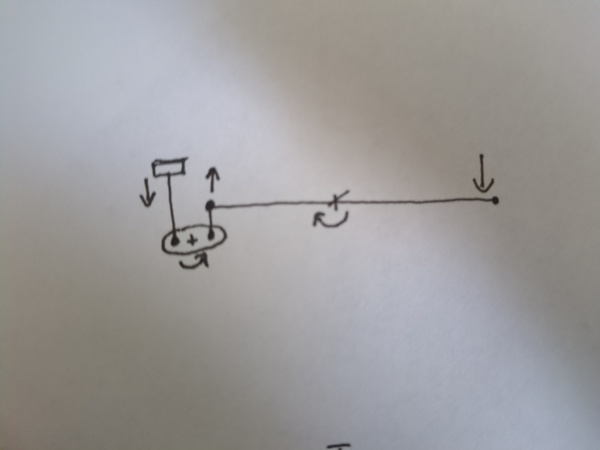
Instead of needing the pivot point to be in the same place, we could have a hole in the "key" part, and use a small pin to tie the motion together at that point. You can easily do it with a 4-bar linkage, I think. What about a compliant mechanism 4-bar linkage? Or is there a simpler option? What about a bellcrank? Does it need 2 bellcranks?
OK, try something like this:
And actually with that we can then keep the pivot point in the same place, which may be desirable.
So when you push down at the right, it goes up about where the hammer is, but that turns a bellcrank at the bottom which pulls the damper down. Simples.
Maybe try this???
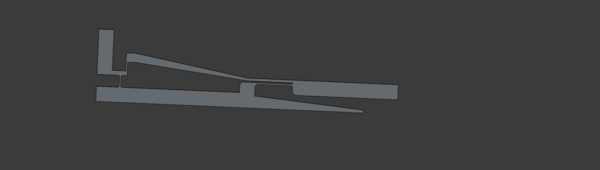
It doesn't look like it will obviously work, but I can't quite tell what is wrong. Possibly the key travel will be too much for the pivot. I'm just going to print it and see how it behaves.
OK, so it totally doesn't work. Pressing the key down just flexes the "hammer spring"-like part, and the damper doesn't move. Forcing the damper down actually lifts the key up.
I think mainly what's happening is that when you push the key down it is pulling the "hammer spring" to the right, much more than it is pushing it upwards.
I'm going through this video series to see if it has any good insights https://www.youtube.com/watch?v=eE53W_Mc8j8
Meh, too long and boring. Let's try this:
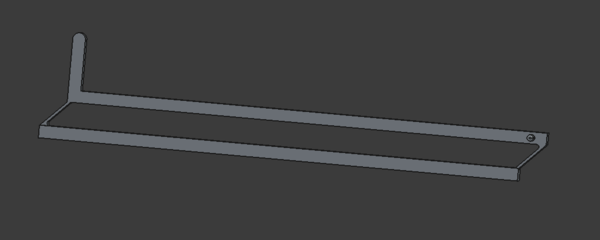
Kind of a 4-bar linkage with a pin connecting it to the main key. The pin is loaded in shear parallel to the layer lines which is obviously not ideal. Can use a metal pin if necessary, but the load is quite low so it may be fine.
Ugh. Another total fail. The flexures are much too short, the long fat part bends more easily than the flexures do.
OK then what about this??
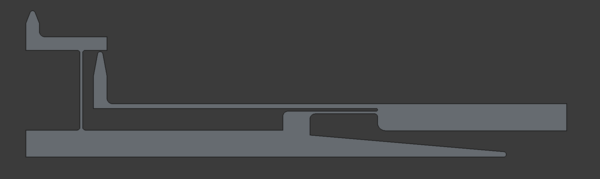
Nope! Still no good. Again the hammer spring part is way more flexible than the damper pivot part.
Also I guess I am kind of expecting the damper part to pivot about the top of the long thin part, but actually it is not like that. The long thin part bends uniformly along its length, which means the damper part moves quite far to the left in the course of moving downwards.
So one problem I really need to fix is the thing where I am trying to make the part to the right of the key pivot match the key machism exactly. This isn't going to work because it is too flexible, I need to forget that idea. Let's say only the block part of the key needs to match, and the rest of it can be whatever is required.
And the second problem is the leverage is really bad and there is too much friction.
What about this??

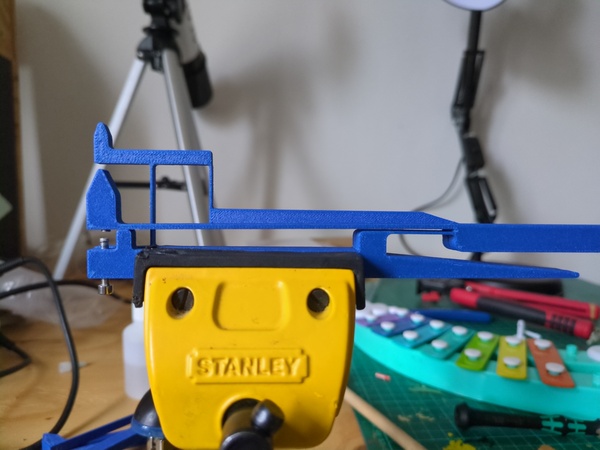
This works! Amazing, finally.
One drawback is that the damper has very little travel, although initial impression is that it's in about the right place anyway.
https://www.youtube.com/watch?v=kLH8pLAS554
So next is:
https://www.youtube.com/watch?v=FxbbTLamWbk - good
< 2026-03-23 2026-03-25 >