Last modified: 2026-11-03 14:55:41
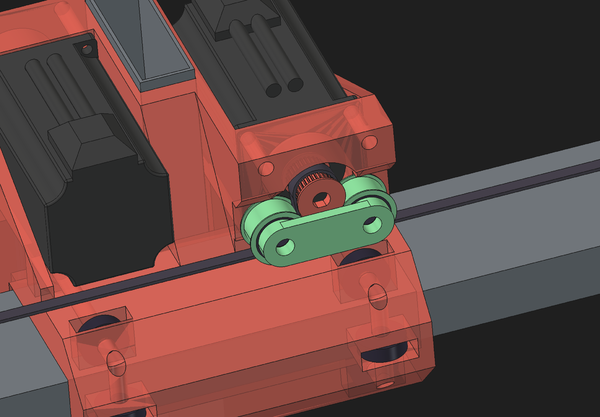
< 2026-11-02OK, new omega drive parts installed and all is well!
The machine can loop around and around over and over again at a decent speed and always end up where it started.
https://www.youtube.com/watch?v=lCDoOU3ay0M
The belt seems to not be tracking very straight so there may be remaining problems, but seems good enough for now.
With one caveat: if I stop the job part way through then it seems to lose work position? I think this may be a gcode sender bug. I've got codex on the case.
Apparently it's because the "restore old work position after reconnection" thing was applying after a soft-reset from stopping the job, and it only had the work position from the last update.
I also have the GX16 connector so could potentially cut some metal under CNC control today.
But first I want to test out the "jog feed override" thing.
So that will be:
Codex suggestion was to use P1 on a jog movement to enable jog feed override, seems pretty good.
error:36, and you can probe for this with a 0-distance jog to find out if supportedhttps://www.youtube.com/watch?v=vtBFtJcfnvs
https://github.com/bdring/FluidNC/pull/1937
I think next is wire up the torch trigger, then tidy up the garage, then work on a "manual Z axis" and torch clamp.
Well I wired it up and tested it out and... there's an interference problem.
I don't know yet whether the Arduino is rebooting or what is going wrong. I did find that sometimes it would trigger the servo alarm. This happens now even if I use the manual torch trigger and not the relay. But this stuff didn't happen when I was just experimenting with loose parts on the garage floor, so it is probably not too far away from working.
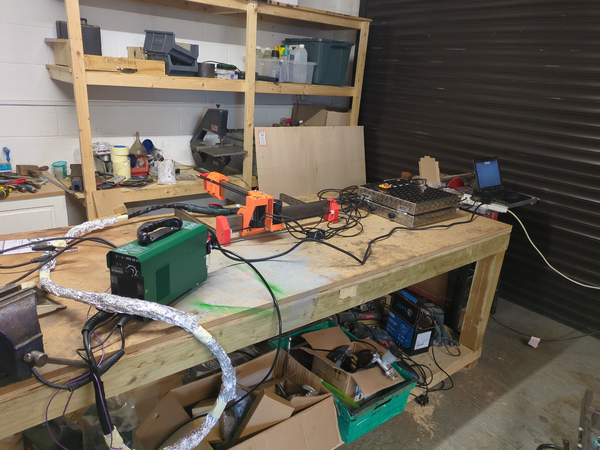
If I tidy up and move the plasma cutter away from the control cabinet and route the cables purposefully instead of all tangled up on the bench that may be enough?? I can also redo the torch trigger cable with a shielded cable, potentially add an EMI filter to the mains input to the control cabinet, what else?
Now laid out like this:
With the torch still controlled manually, I fired it a bunch of times and it eventually triggered the alarm.
I opened up the cabinet and neither of the servos were flashing the alarm LED, so I think the interference was picked up on the wire that goes into the Arduino input and falsely triggered the alarm input.
So what do I do about that? A low-pass filter probably, because the real alarm input is latching. Even if it takes 100ms to trigger that is probably fine. I could probably do that in software rather than adding any hardware in fact, is there a way to put a trigger delay on the alarm input in FluidNC?
I wonder if it's convenient to monitor the alarm input with the oscilloscope to see what is happening?
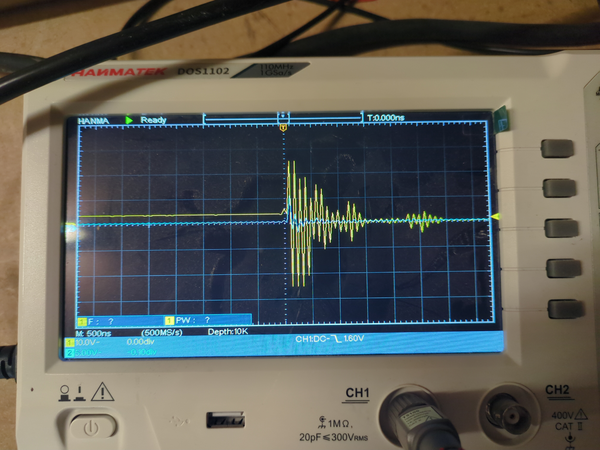
So in that example (N=1, I don't know how representative it is), we get about +/- 25v at peak, and can exceed 5v until about 3us have passed, if I'm interpreting it correctly.
With the probe ground clamp connected directly to the probe (i.e. not measuring anything), I get +/- 10v at peak, so plausibly a lot of the 25v is measurement error.
I tried adding a 4.7k resistor in series with the alarm input, set a program running, and manually lit the torch a bunch of times, it worked fine for maybe 5 squeezes of the trigger, and then triggered the alarm. The servo drive alarms still not triggered, but weirdly FluidNC is in a broken state where I can't unlock the alarm, it then got stuck in "CONNECTING" state over and over again until I power-cycled the Arduino and then worked fine.
What if I disconnect the alarm input completely? I think tie it to ground to make it not-alarmed, and then light the arc a bunch of times and see if there is any problem? If not, I can potentially just run the machine with the servo alarm not connected. Which is actually the way I was using it when testing on the floor.
!!! Works a treat. Check this out: https://www.youtube.com/watch?v=DtY5iqsdsRg
That's FluidNC running a continuous program while the torch is switched on and off, with torch control via the relay. The switch I'm flicking controls the input signal to the relay.
One option would be to use the alarm output to disable the torch relay, instead of as an alarm input to FluidNC, so that it still switches the torch off when triggered.
I have tiny bit of arc eye from looking at the arc, going to buy myself some shade 5 plasma cutting goggles to avoid this in future. They are £8.06 which brings total expenditure up to £102.60, well into triple figures now.
< 2026-11-02