Last modified: 2026-03-23 09:25:00
< 2026-03-21 2026-03-23 >What about this for a Celesta-like instrument?
Imagine a glockenspiel made of very thin bars of metal, laid out on the table, and facing up like a normal glockenspiel.
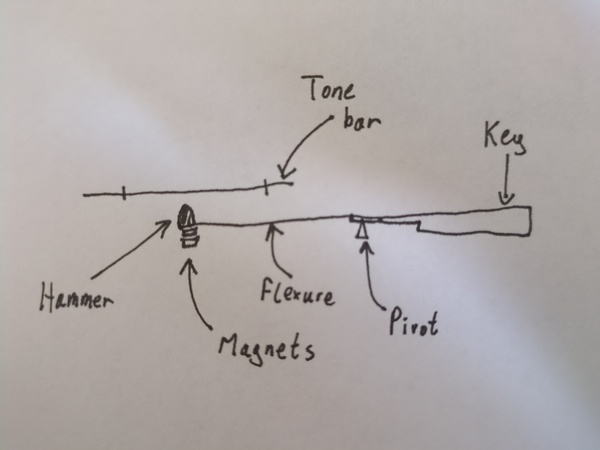
And then there is a keyboard in front of it, each key is a single 3d-printed part, it has a thick solid side that is the key you press on it, a pivot in the middle, and then a thin flexible side the other side of the pivot, with the hammer at the end. There is also a magnet on the bottom of the hammer, and a matching magnet fixed to the case.
At rest, the magnets are stuck together. As you press the key down, the force increases as energy is stored in the flexure, and eventually there is enough force to break free from the magnet, at which point the hammer flies into the bottom of the note and it makes a sound. The hammer relaxes to the equilibrium position (hopefully with no further striking of the note). And then when you release the key the magnet is recaptured ready for another strike.
If you want you can add a felt damper to the key, that touches the tone bar when the key is at rest but is lifted off when you start moving the key.
Potential drawbacks:
You can solve the magnet consistency and clicking noise problem in one go by having the hammer come to a stop against a felt pad when attracted to the magnet, with a slight air gap, and have the magnet on the frame glued to the end of a screw. Wind the screw up/down to bring it closer/further to tune the force.
I think striking the bar more than once is a question of how heavy the hammer is, how springy the flexure is, and there the equilibrium position is when the key is fully pressed, and potentially how hard you press it. You may be able to put some felt on the underside of the flexure so that as it swings back away from the tone bar it loses lots of energy into the felt instead of keeping hold of it. Unsure on that.
"Too quiet" is a question of hammer material and hammer velocity. This may end up OK. I think you can make it louder by using a harder hammer, and you make it faster by increasing the activation force and putting the equilibrium position closer to the bar.
"Too hard to press the key" is a question of leverage and magnet separation force. You can easily make it easier to press the key, at the cost of making it quieter. It's just a tradeoff.
For magnets of adjacent keys interfering, I'm thinking that the activation force of a key may vary depending on whether the adjacent keys are up or down, because it will change the strength of the magnetic field. One option would be to say that we only put static magnets, in the case, and the hammer gets a piece of steel instead of a magnet, so that raising the adjacent hammers doesn't change the field strength. The downside is that the separation force will be lower, but maybe no big deal. And you might get steel at the bottom of the hammer for free if you replace the flexure with a steel strip, although that will then definitely need explicit damping to prevent multiple striking.
First prototype of key mechanism:
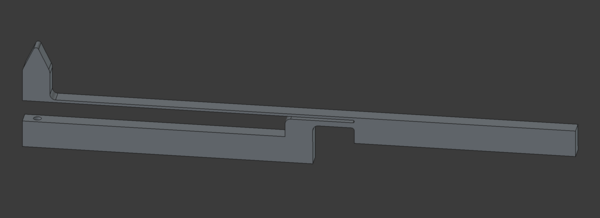
So the hinge here is also a flexure, which I think is elegant but may not be ideal. For the real one maybe you'd prefer to make the base part of the structure out of wood instead, and just put an ordinary pivot in.
There is a hole in the base to screw a M3 screw with magnet on the end. It lacks an end stop for the key, maybe you'd want to extend the base out so that there is something for the key to bottom out on. Or maybe you'd make the end stop with the case instead of making it part of the key mechanism.
I think I'm just going to print this and try it out and see how it works. It is 6mm thick, which I think is more than thin enough to suit.
How wide are normal piano keys? https://music.stackexchange.com/questions/20290/is-there-a-standard-width-for-piano-keys#20297
Let's say we go with the smallest width suggested in that answer, which is 125mm for an octave. An octave contains 12 notes so that is 10.4mm per key. If you leave a 1mm gap then 9.4mm.
OK, first impressions having printed it: