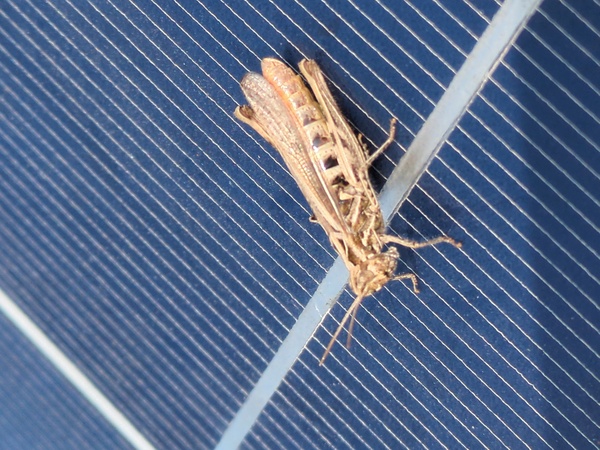
I have a small solar farm and the panels have got visibly dusty. Is cleaning them worthwhile? How much difference does it make? Let's find out.
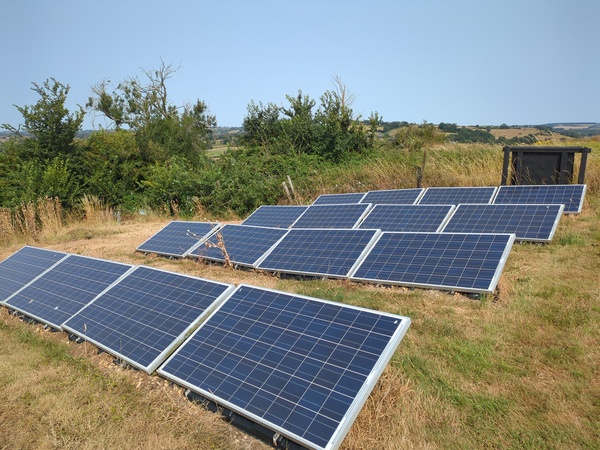
I know that my panels have not been cleaned in the last year. I expect they also weren't cleaned in the year prior to that (why would you clean them when you're about to sell the house?). But beyond that I don't know when they were last cleaned.
Summary
The short answer is that I think I got a 2%-5% increase in power output from my solar farm due to cleaning the panels, which will work out to about £60-£150/yr, decaying to 0 over the course of a few years. So, probably just about worthwhile.
Methodology
There are 16 panels in total, connected up to the inverter as 2 banks of 8 panels each. The inverter reports the power output from each bank individually, so the plan is to take a bunch of readings before starting, then wash all of the panels in one bank, taking readings in between and at the end.
Our hypothesis is that cleaning the panels will increase power output.
We can test whether washing the panels has made any difference by looking at the ratio of power output from the 2 banks. If we just looked at raw power output then it would be confounded by changing cloud cover, sun angle, etc.
There is still the fact that the 2 banks of panels are physically separate and plausibly one bank is better positioned for sun 45 minutes later than the other. Ideally I would have been measuring the ratio of power output for several days prior to see how it varies throughout the day.
This is how the first row of panels looks after I've washed 3 of them, you can see the furthest one is noticeably grubbier:

So they were "visibly dusty", but not massively dirty. If your panels are dirtier than mine were, then your benefit from cleaning them will be greater than mine was.
Results
My results for cleaning one bank of panels are shown in this chart:

We see that the initial power ratio is very stable before the panels are washed.
We then step up to having washed "half" a panel (I initially tried to wash them with window cleaner and a paper towel, but this was ineffective so I then walked away to get a bucket of soapy water and a cloth, and then took a reading which I labelled as 50% washed).
For some reason the power ratio drops significantly when the first panel is washed, I'm unsure why.
And then the power ratio increases as more panels are washed as we'd expect.
But once all the panels are washed, the power ratio drops off again while nothing changes. I am unsure whether this is because as the surface water evaporates off the panels get slightly opaque again? Like the "frosted glass effect", where you can see through frosted glass when it is wet but it gets opaque again when dry. Maybe beyond cleaning the panels I ought to be polishing them?
Anyway it looks like cleaning the panels was about a 2%-5% improvement, depending on what you think is going on at the end.
Tingle
I got a bit of a tingle when I was cleaning one of the panels. At first I thought I was getting an electric shock from the wet panel, but I inspected my finger and found a tiny thistle splinter in it. After I removed the splinter it seemed fine.
But a bit later I got another tingle from another panel! There definitely wasn't a splinter in my finger any more, but the tingle was in the same place. I think the tingle actually was coming from the electricity, but I was only able to feel it at the point where the thistle had already pierced the skin.
ChatGPT convinced me that there could just be a tiny "capacitive leakage" from an "inverter with no transformer", so I'm not going to worry about it. But if I clean the panels again I will wait until dark lol.
Upgrading
The next question is should I be upgrading the solar farm? I think mine was installed about 15 years ago, and generates (at peak output) 3.7 kW from 16 panels.
Correct me if I'm wrong on any of this:
Replacing the panels with more modern ones would increase the power output by about 60%, at a cost of about £5000, which would pay for itself in about 3 years, which seems like a no-brainer.
However, due to the fact that my solar farm was installed so long ago, it benefits from a feed-in tariff, which means that not only do I get paid an absurdly high rate, but it is paid also based on the electricity I generate rather than what I export.
If I increase the power output of the system then the additional capacity will not be eligible for the feed-in tariff and will revert to present-day prevailing tariff which is about 4x worse before you even consider that I currently get to use electricity and still get paid for generating it.
This is the yin and yang of market-distorting incentives. Today's incentive to install solar becomes tomorrow's disincentive to upgrading it.