
We are soon (?) going to have autonomous or semi-autonomous humanoid robots that are actually good enough to use.
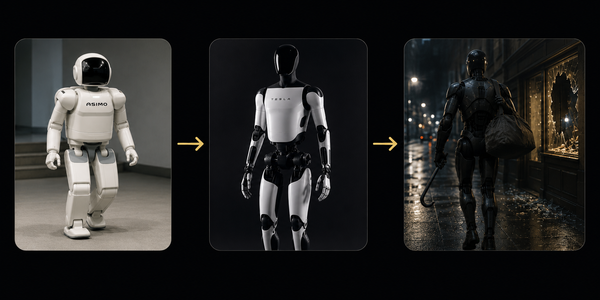
Will we start seeing burglaries, or other physical-world crimes, committed by remote-operated humanoid robots?
As for their present-day capabilities, YouTube has a Tesla Optimus doing kung-fu, a Boston Dynamics Atlas running around and break-dancing, and the Beijing humanoid robot olympics.
I know, I know, these all kind of suck, and they don't look like they'd be good at breaking or entering. But they'll get better.
It's not hugely material whether the robot is operating fully autonomously or is more like a dumb remote-controlled robot that you simply operate remotely, as long as it's capable enough to get it to do what you want.
The advantage to the criminal is that they get a physical body that can operate in the real world, but if it gets subdued or injured or arrested they face basically no consequences as long as nothing physically present on the robot can trace it back to them. They're out the cost of the hardware but nothing else.
And on top of being a "burner embodiment", it could easily end up being physically stronger than a human, faster at running, able to squeeze through smaller gaps, jump over higher fences, whatever you need.
Obviously you can expect that a robot from Tesla would be much too surveillant for you to be able to get away with using it to burgle, because they'll know who you are, and probably the guardrails will try to enforce using it for good rather than evil (or, at least, using it only for tasks safely within the corporate Overton Window). But the technology will be commoditised in time, you can't stop that. And if you can hack or steal someone else's Tesla robot then you might be able to use a Tesla one for crime anyway.
I'm mainly posting this so that I can point to it in the future when this kind of thing is in the news.
My post ends here, but if you are interested in a ChatGPT vignette...
The robot came down the high street at 3:17 a.m., walking badly. Not falling-over badly, but wrong: knees rising too high, head too still, arms hanging with the patience of machinery. Someone had taped a hi-vis vest around its torso, and in the rain it shone like a workman sent to do a job nobody had approved. It stopped outside Braithwaite & Son, jewellers since 1898.
In a bedroom thirty miles away, Tom crouched over a borrowed headset, both hands sweating on the controls. His friends were in his ear, tinny and breathless. “Do it,” said Ash. “Pick it up.” The robot bent, corrected itself, and got both hands under a loose paving slab. It dropped it once. Everyone on the call swore. The second time, the swing was better. The shop window went white, then black, then loud, and the alarm began screaming into the empty street.
The robot climbed through the broken window with the grace of a fridge committing a crime. Glass slid under its feet; for one strange second it looked almost human, trying not to fall. Then Tom had it grabbing at whatever glittered: chains, bracelets, rings still sitting in their trays. Half of it missed the bag taped to the robot’s chest and scattered across the floor. “Forget the floor,” Ash said. “Go, go, go.” Blue light began to pulse at the far end of the street.
The police arrived in four minutes. A constable stepped out into the rain and shouted, “Stop!” The robot stopped. Later, that was the clip everyone shared: the machine in its hi-vis vest, jewellery clutched in both hands, briefly obeying the law. Then Ash screamed, “Run!” and Tom made it run, badly, knees pumping, one arm swinging, the other held rigid against its chest to keep the bag from tearing loose.
It reached the service lane behind the shops with the police close enough for their torches to catch the rain around it. At the bins, Tom made the robot open its hand. Gold dropped into the rubbish under cardboard, coffee grounds, and split tomatoes. Then he sent it on towards the river. By then everyone on the call was shouting, laughing, begging him not to stop. The feed broke twice before the robot found the bank, slipped, corrected too late, and went down hard into the ditch.
The police found it forty minutes later, face down in brown water, still trying to crawl. By breakfast, everyone had seen the video. By lunch, there were calls for new laws. By evening, Braithwaite & Son had boarded the window and the police had taken the robot away on a flatbed, dripping ditch-water onto the road. Two nights later, a hooded twelve-year-old lifted the lid of the trade bin behind the jeweller’s and retrieved his prize.